Understanding what constitutes a good SAT score is crucial for students preparing for college admissions in 2026. The answer isn't one-size-fits-all-it depends on your target universities, academic goals, and competitive landscape. Whether you're aiming for Ivy League institutions or state universities, knowing where you stand and what scores you need can transform your preparation strategy and boost your confidence throughout the testing process.
Understanding SAT Scoring Fundamentals
The SAT scoring system operates on a scale from 400 to 1600, combining two section scores: Evidence-Based Reading and Writing (EBRW) and Math. Each section is scored between 200 and 800 points.
The composite score represents your total performance across both sections. When colleges evaluate applications, they typically look at both your composite score and individual section scores to assess your strengths and readiness for college-level coursework.
According to College Board’s official scoring guidelines, the average SAT score nationally hovers around 1050. However, this benchmark alone doesn't tell the complete story. The middle 50% of test-takers score between 1000 and 1200, placing you in various percentile rankings depending on where your score falls within this range.
Breaking Down Section Scores
Understanding section-specific performance helps identify areas for improvement:
- Math Section: Scores of 600+ place you above the 75th percentile
- Reading and Writing Section: Scores of 600+ similarly demonstrate strong performance
- Combined Excellence: Achieving 1200+ total puts you in the top 25% of test-takers
Defining a Good SAT Score for Your Goals
A good SAT score is fundamentally relative to your college aspirations. What qualifies as excellent for one institution might be average for another. The key is researching your target schools and understanding their admitted student profiles.
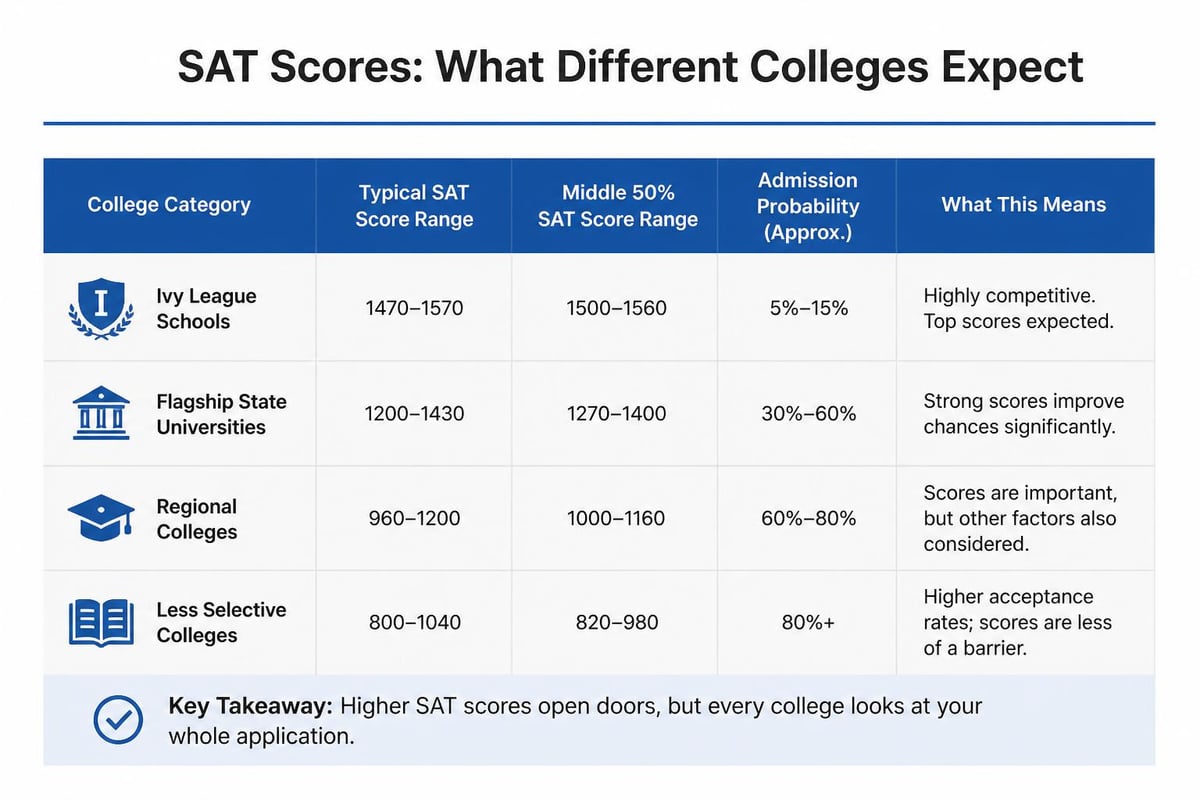
Most competitive universities publish the middle 50% SAT score range for their admitted students. This range represents the 25th to 75th percentile scores. Landing within or above this range significantly strengthens your application.
| College Tier | Typical Score Range | Percentile Ranking |
|---|---|---|
| Highly Selective (Ivy League) | 1450-1570 | 97th-99th |
| Selective Universities | 1300-1450 | 87th-97th |
| Moderately Selective | 1150-1300 | 67th-87th |
| Less Selective | 1000-1150 | 40th-67th |
BestColleges explains that aiming for scores within the middle 50% range of your target institutions gives you the best chance of admission consideration. If your score falls below the 25th percentile, you'll need exceptional strengths in other application areas.
Three Ways to Define Your Target Score
1. National Average Benchmark: Scoring above 1050 means you've performed better than half of all test-takers. This represents a baseline good SAT score for many state universities and less competitive institutions.
2. College-Specific Targets: Research each school's admitted student data. For example, UCLA's middle 50% ranges from 1290 to 1510, meaning 1400+ would be competitive.
3. Scholarship Qualifications: Many merit-based scholarships require minimum scores, often ranging from 1200 to 1400 depending on the program and institution.
Score Benchmarks by University Type
Different universities maintain varying standards for what they consider competitive scores. Understanding these distinctions helps set realistic yet ambitious goals.
Elite Universities
Top-tier institutions like Harvard, Stanford, and MIT typically see admitted students with scores between 1450 and 1570. These schools admit students in the 97th percentile or higher. However, even perfect scores don't guarantee admission-these universities evaluate applications holistically.
At this level, a good SAT score means being at or above the 75th percentile for admitted students. Anything below 1450 requires exceptional achievements in extracurriculars, essays, or unique circumstances to remain competitive.
Competitive State Universities
Public universities like University of California campuses, University of Michigan, and University of Virginia typically seek students scoring between 1250 and 1450. This range represents strong academic preparation while remaining more accessible than elite private institutions.
For these schools, a good SAT score falls between 1300 and 1400, placing you comfortably within their admitted student profile. Scores above 1400 may qualify you for honors programs or merit scholarships.
Regional and Community-Focused Institutions
Many excellent regional universities and liberal arts colleges accept students with scores ranging from 1000 to 1200. These institutions often emphasize fit, character, and potential over pure test scores.
A good SAT score for these schools typically means 1100+, demonstrating college readiness while leaving room for other application strengths to shine. Many students thrive at these institutions regardless of their test scores.
Understanding Percentiles and Your Competitive Position
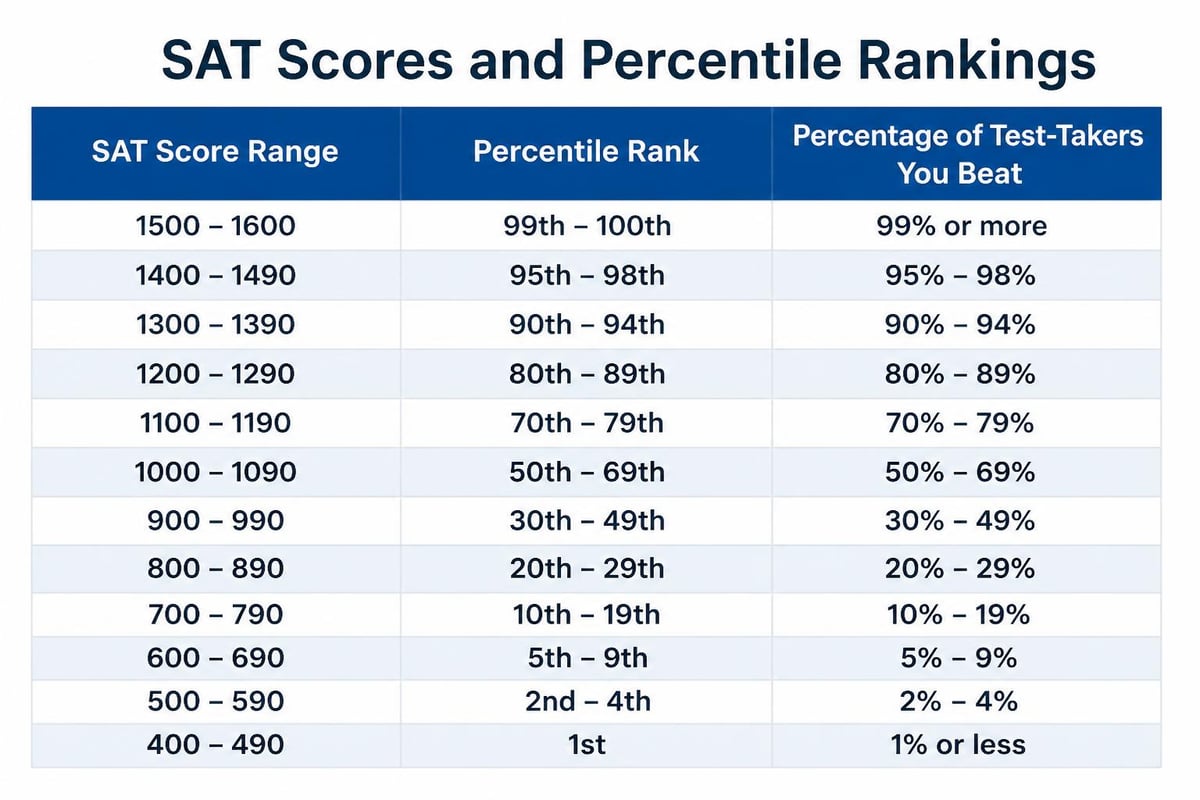
Percentile rankings reveal how your score compares to other test-takers nationally. A percentile of 75 means you scored better than 75% of students who took the exam.
Key Percentile Benchmarks
- 1600: 99th+ percentile (perfect score)
- 1500: 99th percentile
- 1400: 94th percentile
- 1300: 87th percentile
- 1200: 75th percentile
- 1100: 59th percentile
- 1000: 40th percentile
Coursera’s comprehensive guide emphasizes that understanding percentiles helps students set appropriate goals based on where they want to position themselves competitively. Moving from the 75th to 87th percentile requires approximately 100 additional points, representing significant improvement.
The relationship between raw scores and percentiles isn't linear. Gaining 100 points from 900 to 1000 moves you up more percentile points than gaining 100 points from 1400 to 1500, due to score clustering around the middle ranges.
Section-Specific Score Goals
Both SAT sections carry equal weight in your composite score, but some programs value specific sections differently. Engineering programs often emphasize Math scores, while humanities programs may weigh Reading and Writing more heavily.
Math Section Excellence
The Princeton Review outlines benchmarks for Math scores, noting that 600+ represents solid performance. For STEM-focused students, targeting 700+ demonstrates quantitative readiness for rigorous coursework.
Math section scoring considerations:
- 750-800: Exceptional, competitive for top engineering programs
- 650-750: Strong, suitable for most selective universities
- 550-650: Average, meets requirements for many programs
- Below 550: Requires improvement for competitive admissions
Reading and Writing Performance
Strong Reading and Writing scores demonstrate critical thinking, comprehension, and communication skills essential for college success. This section proves particularly important for humanities, social sciences, and liberal arts programs.
A good SAT score in Reading and Writing typically means:
- 700+: Demonstrates exceptional verbal reasoning and analytical skills
- 600-700: Shows solid preparation and college readiness
- 500-600: Meets minimum requirements but leaves room for improvement
- Below 500: Suggests need for focused preparation strategies
Students often find Reading and Writing more challenging to improve quickly compared to Math, making early preparation essential.
How Your Score Impacts College Admissions
SAT scores function as one component within a holistic admissions process. While important, they don't singularly determine your admission fate. Understanding how colleges weigh standardized testing helps contextualize what constitutes a good SAT score for your specific situation.
Test-Optional Policies
Many universities have adopted test-optional or test-flexible policies, particularly following recent trends in higher education. However, submitting strong scores can still benefit your application significantly. If your score falls within or above a school's middle 50% range, including it strengthens your candidacy.
Test-optional doesn't mean test-blind. Admissions officers still value strong scores as one indicator of academic preparation. Students with scores in the top 25% of admitted students should absolutely submit them, even at test-optional institutions.
Balancing Score Goals with Other Factors
Your GPA, course rigor, extracurricular involvement, essays, and recommendations collectively paint your application picture. A slightly lower SAT score paired with exceptional achievements elsewhere can succeed at competitive institutions.
Conversely, focusing exclusively on achieving a perfect score while neglecting other application components creates an unbalanced profile. Aim for a good SAT score that meets your target schools' expectations, then invest remaining time strengthening other areas.

Strategic Preparation for Score Improvement
Achieving a good SAT score requires structured preparation, consistent practice, and strategic test-taking skills. Most students improve significantly between their first attempt and subsequent tests with proper preparation.
Setting Realistic Score Goals
Begin with a diagnostic test to establish your baseline. This reveals your current performance level and areas needing improvement. From there, set incremental goals leading toward your target score.
Realistic improvement expectations:
- First-time test-takers: 100-200 point improvement with 2-3 months of consistent study
- Repeat test-takers: 50-150 point improvement with focused preparation on weak areas
- Long-term preparation: 200-300+ point improvement possible over 6-12 months
Research from PrepScholar about good SAT scores in 2026 indicates that students who engage in structured preparation programs typically achieve more substantial improvements than those studying independently.
Evidence-Based Study Strategies
Different approaches work for different learners, but certain strategies consistently produce results:
- Complete full-length practice tests under timed conditions monthly
- Analyze mistakes systematically to identify patterns and knowledge gaps
- Focus on weak areas while maintaining strengths
- Learn test-taking strategies specific to SAT question formats
- Build vocabulary and reading stamina gradually over time
Quality matters more than quantity in SAT preparation. Three hours of focused, strategic study outperforms ten hours of unfocused practice.
Test-Taking Timing and Multiple Attempts
Most students take the SAT two to three times before submitting college applications. Understanding optimal timing and how multiple scores work helps maximize your potential.
When to Take Your First SAT
Junior year spring (March-June) represents the ideal timeframe for most students' first attempt. This allows adequate preparation time while leaving room for retakes if needed. Some advanced students take it earlier in junior year after completing relevant coursework.
Taking the SAT during sophomore year can establish a baseline, but substantial score improvements typically occur after additional academic preparation. Early testing works best for students completing advanced coursework ahead of schedule.
Maximizing Multiple Attempts
Colleges generally consider your highest scores, either through superscoring (combining best section scores across tests) or accepting your highest single sitting. This policy reduces pressure and allows strategic retesting.
Retake considerations:
| Scenario | Recommended Action |
|---|---|
| Score below target by 100+ points | Definitely retake after focused preparation |
| Score within 50 points of target | Consider retake if time/resources allow |
| Score exceeds target | Only retake if aiming for merit scholarships |
| Three previous attempts | Unlikely to see significant improvement |
IvyWise’s guidance on good SAT scores emphasizes that students should retake the test when they have specific reasons to believe scores will improve, not simply hoping for better results without changed preparation.
Score Reporting and Strategic Submission
Understanding score reporting options helps you present your strongest testing profile to colleges. Score Choice policies vary by institution, making research essential before test day.
Superscoring Benefits
Many universities superscore the SAT, combining your highest section scores from multiple test dates. This policy significantly benefits students who improve unevenly across sections.
For example, if you scored 650 Math/600 Reading in June, then 600 Math/680 Reading in August, your superscore would be 1330 (650 Math + 680 Reading) rather than either individual sitting's composite.
Score Reporting Strategies
Most colleges accept scores from multiple test dates, but policies differ:
- Score Choice Accepted: Submit your best scores from chosen test dates
- All Scores Required: Submit every SAT taken (but schools typically consider best)
- Superscore Policy: Schools recalculate using best section scores across dates
Before registering, verify each target school's requirements. This information appears on admissions websites and guides your testing strategy.
International Student Considerations
Students applying to U.S. universities from abroad face additional considerations when determining what constitutes a good SAT score for their circumstances. International competition often intensifies, particularly from regions with high applicant volumes.
Competitive Benchmarks for International Applicants
International students often need higher scores to stand out, particularly when applying without demonstrated English proficiency through other means. Many competitive universities expect international students to score above the 75th percentile of admitted students.
For universities requiring both SAT and English proficiency tests like TOEFL, strong SAT Reading and Writing scores can strengthen your overall linguistic competency profile. Scores of 650+ in Evidence-Based Reading and Writing demonstrate advanced English skills.
If you're preparing for multiple standardized tests, exploring comprehensive test preparation courses that address both SAT and English proficiency exams can optimize your study efficiency and results.
Financial Aid and Merit Scholarship Implications
A good SAT score extends beyond admission considerations-it directly impacts merit-based financial aid opportunities. Many universities offer automatic scholarships based on standardized test scores and GPA combinations.
Scholarship Score Thresholds
Merit scholarships often establish clear score cutoffs:
- Full-tuition scholarships: Typically require 1450-1500+ scores
- Substantial merit aid: Often begins at 1350-1400
- Partial scholarships: May start as low as 1200-1250
These thresholds vary dramatically by institution. State universities often provide more generous automatic scholarships for high-scoring in-state students, while private universities may reserve merit aid for exceptionally high scorers.
Research from College Values Online demonstrates that students scoring in the top 10% of admitted students at their enrolled institution receive merit aid at significantly higher rates than average-scoring admits.
ROI of Score Improvement
Improving your score by 50-100 points can translate to thousands of dollars in annual scholarship money. For students near scholarship thresholds, focused preparation targeting specific point improvements represents excellent financial investment.
Calculate potential scholarship value when deciding whether to retake the exam. If raising your score from 1280 to 1300 qualifies you for an additional $5,000 annually, that 20-point improvement is worth $20,000 over four years.
Common SAT Score Misconceptions
Several myths about SAT scores persist despite evidence to the contrary. Clarifying these misconceptions helps students set appropriate expectations and strategies.
Myth: You Need a Perfect Score
Reality: Perfect scores are impressive but unnecessary for admission to even the most selective universities. Harvard's middle 50% ranges from 1460 to 1570, meaning 25% of admitted students scored below 1460.
Focus on achieving a good SAT score within your target schools' ranges rather than pursuing perfection. Beyond certain thresholds, incremental improvements provide diminishing returns on admission chances.
Myth: The First Score Is the Best Score
Reality: Most students improve significantly with additional attempts and preparation. According to UWorld’s analysis of good and bad SAT scores, average improvement between first and second attempts ranges from 40-90 points.
Strategic preparation between attempts drives improvement. Simply retaking without addressing weaknesses rarely produces substantial gains.
Myth: SAT Scores Alone Determine Admission
Reality: Holistic admissions processes evaluate multiple factors. Strong scores open doors, but essays, recommendations, activities, and demonstrated interest all contribute to admission decisions. Students with lower scores but exceptional other qualities gain admission regularly.
Digital SAT Changes and Implications
The transition to the Digital SAT in recent years has modified testing experiences and scoring considerations. Understanding these changes helps students prepare appropriately.
Adaptive Testing Features
The Digital SAT uses adaptive testing, adjusting question difficulty based on your performance. This means two students can receive the same score while answering different questions. The adaptive format typically reduces overall test time while maintaining score validity.
For test-takers, this creates a different strategic environment. Strong performance on initial questions leads to harder subsequent questions, which paradoxically indicates good performance even if they feel more challenging.
Scoring Consistency
Despite format changes, score ranges and percentiles remain consistent with previous SAT versions. A good SAT score in 2026 means the same thing it meant previously in terms of percentiles and college competitiveness.
However, some students perform better with digital formats due to features like built-in calculators, easier passage navigation, and shorter testing sessions. Practice with the digital format specifically ensures familiarity and optimal performance.
Subject-Specific Preparation Priorities
Effective SAT preparation requires understanding where to invest your study time for maximum impact. Different score ranges benefit from different preparation strategies.
For Students Scoring Below 1000
Focus on foundational skills: Basic algebra, grammar rules, reading comprehension strategies, and test-taking time management. At this level, mastering fundamentals produces rapid improvement.
Priority areas include:
- Core mathematical operations and basic algebra
- Grammar and sentence structure rules
- Reading comprehension and inference skills
- Vocabulary building through context
- Pacing and question selection strategies
For Students Scoring 1000-1200
Expand knowledge and refine strategies: Strengthen advanced concepts while polishing test-taking efficiency. Improvement at this level comes from both content mastery and strategic optimization.
Target development in:
- Advanced algebra and introductory trigonometry
- Complex sentence structures and rhetorical analysis
- Evidence-based reading and multi-paragraph synthesis
- Advanced vocabulary in context
- Eliminating careless errors through careful checking
For Students Scoring 1200+
Perfect execution and master difficult concepts: At this level, achieving a good SAT score means minimizing mistakes and mastering the most challenging question types.
Focus includes:
- Complex problem-solving in advanced mathematics
- Nuanced reading comprehension and author's purpose
- Sophisticated grammar rules and style questions
- Data analysis and scientific reasoning passages
- Optimal time allocation across question difficulties
Regional and Cultural Context Factors
Students in different regions and educational systems may have varying perspectives on what constitutes a good SAT score. Understanding your competitive context helps set appropriate goals.
South Asian Educational Context
In Pakistan and surrounding regions, students often target highly competitive U.S. universities, making score expectations particularly stringent. Many successful applicants from this region score above 1400 to stand out in competitive applicant pools.
Students preparing in Lahore and similar educational centers benefit from understanding both U.S. national averages and the competitive landscape among their peer group. Regional test preparation resources tailored to local student needs can provide significant advantages in achieving target scores.
Comparing Educational Systems
Students transitioning from different educational systems may find certain SAT sections more challenging based on curriculum emphases. British O/A Level students often excel in structured testing but may need additional support with SAT-specific formats and strategies.
Understanding your educational background's strengths and gaps helps customize preparation approaches. Students from mathematics-focused curricula may achieve higher Math scores more easily, while those from literature-rich programs might excel in Reading and Writing with less preparation.
Achieving a good SAT score requires understanding your target universities' expectations, strategic preparation, and consistent effort across all test sections. Whether you're aiming for 1200 or 1500, setting realistic goals based on your college aspirations and preparing systematically makes the difference between hoping for success and achieving it. If you're ready to maximize your SAT performance and gain admission to your dream university, Tutex Academy provides certified trainers, personalized coaching strategies, and weekly mock tests with a score improvement guarantee designed specifically for students in Lahore pursuing international education opportunities.
Article written using RankPill.